Get Started Today
Modern Karate is predominantly a striking art using punching, kicking, knee and elbow strikes, and open hand techniques such as knife-hand, spear-hand, and palm-heel strikes. Historically and in some modern styles grappling, throws, joint locks, restraints, and vital point strikes are also included.
At SMAA we study the Karate kata of the WKKJO, which is a traditional practice of Okinawa Japan that has been passed from teacher to student for over 300 years. At SMAA, this tradition continues under the direction of Simon Sherbourne 7th Dan (RHKKF), M.Ed.
Common Skills/Techniques Learned
- The “One Punch Finish” is a reality with proper karate training,
- Leg kick/ front, side, round kick to the opponent's knee or thigh,
- Using distance and angle to manage your selection of techniques and movement (punches, kicks, throws, and finishing techniques)


Traditional Karate Kata taught through the WKKJO
Table: Karate Kata of the WKKJO. (Mostly of the Shuri-te lineage from Seikichi Odo of Okinawa)
| Karate Kata | Teacher | Lineage | |||||
|---|---|---|---|---|---|---|---|
| Naihanchi Shodan | Sherbourne | Odo | Nakamura | Choki Motobu | Itosu | Matsumura | Shuri-Te |
| Naihanchi Nidan | Sherbourne | Odo | Nakamura | Choki Motobu | Itosu | Matsumura | Shuri-Te |
| Naihanchi Sandan | Sherbourne | Odo | Nakamura | Choki Motobu | Itosu | Matsumura | Shuri-Te |
| Wansu | Sherbourne | Odo | Toma | Kyan, Chotoku | Itosu | Matsumura | |
| Seisan | Sherbourne | Odo | Nakamura | Kuniyoshi | Sakiyama | Ason/Rurko | Naha-Te |
| Aanku | Sherbourne | Odo | Toma | Kyan, Chotoku | Itosu | Matsumura | Naha-Te |
| Pinan Shodan | Sherbourne | Odo | Nakamura | Hanashiro | Itosu | --- | Shuri-Te |
| Pinan Nidan | Sherbourne | Odo | Nakamura | Hanashiro | Itosu --- | --- | Shuri-Te |
| Pinan Sandan | Sherbourne | Odo | Nakamura | Hanashiro | Itosu --- | --- | Shuri-Te |
| Pinan Yondan | Sherbourne | Odo | Nakamura | Hanashiro | Itosu --- | --- | Shuri-Te |
| Pinan Godan | Sherbourne | Odo | Nakamura | Hanashiro | Itosu --- | --- | Shuri-Te |
| Gojushiho Ichi | Sherbourne | Odo | Matayohsi, Shinpo | Matayohsi, Shinko | Agena | Matsumura | Shuri-Te |
| Gojushiho Ni | Sherbourne | Odo | Toma | Kyan, Chotoku | Itosu | Matsumura | Shuri-Te |
| Niseishi | Sherbourne | Odo | Nakamura | kuniyoshi | Sakiyama | Ason/Rurko | Shuri-Te |
| Kusanku | Sherbourne | Odo | Toma | Kentsu | Itosu | Matsumura | Shuri-Te |
| Passai | Sherbourne | Odo | Nakamura | Hanashiro | Itosu | Matsumura | Shuri-Te |
| Chinto | Sherbourne | Odo | Nakamura | Kyan, Chotoku | Itosu | Matsumura | Shuri-Te |
| Sanchin | Sherbourne | Odo | Toma | Kyan, Chotoku | Naha-Te | ||
The Origins of Karate and our Lineage
Simon Sherbourne is one of Hanshi Odo Sensei’s senior students who chooses to carry on his teachings for the next generation of Budo-Ka through the WKKJO.
Karate 空手; Japanese pronunciation is a martial art developed on the Ryukyu Islands in what is now Okinawa, Japan. It developed from the indigenous martial arts of the Ryukyu Islands: called te 手, literally meaning "hand"; tii in Okinawan under the influence of Chinese martial arts, particularly Fujian White Crane.
Karate is now predominantly a striking art using punching, kicking, knee and elbow strikes, and open hand techniques such as knife-hand, spear-hand, and palm-heel strikes. Historically and in some modern styles grappling, throws, joint locks, restraints, and vital point strikes are also included. A karate practitioner is called a karate-ka (空手家).
The origins and influences that contributed to current traditional Okinawan Karate and Kobudo stem back approximately 1000 years to the time of the Bodhidarma. A very detailed article which outlines the general development of Karate from this time period forward (Opens in a new window).
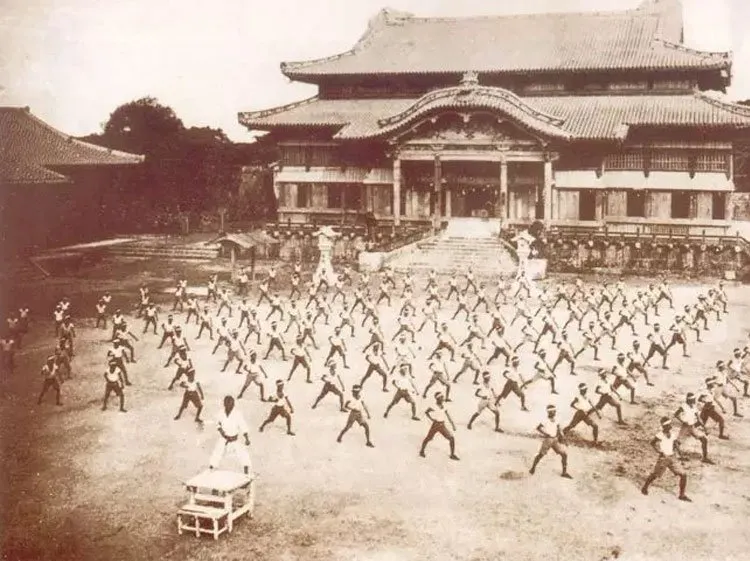
Karate eventually developed in the Ryukyu Kingdom around the late 1300's to early 1400's . Through various Chinese and Japanese occupations Karate evolved in Okinawa as a distinct martial art. The influences of Zen and Buddhism fostered discipline and the indomitable spirit of the Karate-ka. Karate was brought to the Japanese mainland in the early 20th century during a time of cultural exchanges between the Japanese and the Chinese. It was systematically taught in Japan.
In 1922 the Japanese Ministry of Education invited Gichin Funakoshi to Tokyo to give a karate demonstration. In 1924 Keio University established the first university karate club in mainland Japan and by 1932, many major Japanese universities had karate clubs. In this era of escalating Japanese militarism, the name was changed from 唐手 ("Chinese hand" or "Tang hand") to 空手 ("empty hand") – both of which are pronounced karate – to indicate that the Japanese wished to develop the combat form in Japanese style. After World War II, Okinawa became an important United States military base and karate became popular among servicemen stationed there.
Hakutsuru Ichi and Hakutsuru Ni were taught by Master Odo in the summer of 1994 along with Kobudo Kata: Chatanyara No Sai and Miazato No Tekkos Ichi and Ni (This totals 20 Empty Hand Kata taught by Master Seikichi Odo at the time of his passing in March, 2002).
Teachers who have passed on the Kata of the WKKJO:
- Seikichi Odo,
- Shigeru Nakamura,
- Shinkichi Kuniyoshi,
- Seiki Toma,
- Chotoku Kyan,
- Shinpo Matayoshi,
- Chomo Hanashiro,
- Shinko Matayoshi,
- Yabu Kentsu,
- Anko Itosu,
- Sokon Matsumura,
- Karate Sakugawa
Karate Sakugawa: Sakugawa Kanga, 1733 - 1815), also Sakugawa Satunushi[1] and Tode Sakugawa,[1] was a Ryūkyūan martial arts master and major contributor to the development of Te, the precursor to modern Karate.
Sokon Matsumura was the senior student of Sakugawa Sensei.
See Bushi Matsumura's (1800 - 1892?) story.
Anko Itosu (1831- 1915)
Notable students of Itosu included:
- Choyu Motobu (1857–1927),
- Choki Motobu (1870–1944),
- Yabu Kentsu (1866–1937),
- Chomo Hanashiro (1869–1945),
- Moden Yabiku (1880–1941),
- Kanken Toyama (1888–1966),
- Chotoku Kyan (1870–1945),
- Shinpan Shiroma (Gusukuma) (1890–1954),
- Anbun Tokuda (1886–1945), Kenwa Mabuni (1887–1952), and
- Chōshin Chibana (1885–1969)
It is with Itosu Sensei that we see a great proliferation of Okinawa's Karate.
Shinkichi Kuniyoshi (1848-1926) taught Shigeru Nakamura;
Chomo Hanashiro's (1869 - 1945 Shuri-Te lineage): Senior student was Shigeru Nakamura
Shigeru Nakamura 1894 - 1969 - Okinawa Kenpo: was the primary teacher of Seikichi Odo
Seikichi Odo (July 26, 1927 – March 24, 2002) Founder of the RHKKF (Ryukyu Hon Kenpo Kobujyutsu Federation) was the primary Karate and Kobudo teacher of Simon Sherbourne (November 22, 1967 - ) Founder and Director of the WKKJO.
Karate of old was simply called “Te” in Japanese, or “Ti” (sometimes spelled as “di”) in the older original language of Uchina (Okinawa). This was from the original “Toudi”, which meant “Chinese Hand” (Tou being a reference to the Tang dynasty in China), but the point is that there was only one “Te”.
Even the naming of the 3 main branches of Karate (Suri-te, Tomari-te, and Naha-te) did not emerge until the 1920s or 1930s when the masters had to come up with names when presenting the art to the Japanese. As S. Sherbourne understands it, even these names were implemented to acknowledge each lineage with an identity (some would say that Naha-te did not even exist, and was created simply to appease Chojun Myagi and give his style of Goju Ryu some representation and back-lineage). This makes sense, given the fact that our Kata (RHKKF and the WKKJO) are primarily of the Shuri-te lineage, which is by far the main lineage and influence on modern-day Karate.
Many think of him as a bad-ass (and for his time, he certainly was), but if you read his teachings it shows that he was dealing with the same noise over 100 years ago that we are dealing with today – and this is obvious in a great quote from Motobu:
“Nothing is more harmful to the world than a martial art that is not effective in actual self-defense.”
He was facing the same issues and dealing with the same types of ineffective martial arts driven by ego rather than effectiveness that we deal with today. So he chose to challenge and test his technique, and his conclusions led him to take it back to simplicity – he stated many times that Naihanchi kata has everything a person needs to know (he viewed this Kata as a complete system of self-defense that could be studied for years). Despite what people think, Motobu did learn other Kata, but he chose to focus on Niahanchi sho-dan as his primary training tool – it was simple, brutal, effective, and it contains all of the key combative techniques in your list below.
Master Shigeru Nakamura 1893 - 1969(
Master Seikichi Odo's Main Karate Instructor):
Master Nakamura lived in the City of Nago. His first introduction to karate was at the Icchu Middle School, in Shuri, Okinawa. His instructors included Kanryo Higashionna, Kentsu Yabu & Chomo Hanashiro. Yastune Itosu also made periodic visits to the school. After graduating from the middle school, Nakamura returned to Nago, where he continued learning Karate under Shinkichi Kunioshi, the successor to the legendary Naha "Bushi" Sakiyama. Shigeru Nakamura established his own dojo in Nago City in 1953.
The "Okinawa Kenpo Renmei" was formed by Zenryo Shimabuku and Shigeru Nakamura in 1955, with Nakamura as President. Master Nakamura was known for developing full contact sparring using "Bogu Gear".
Master Seikichi Odo 1926 - 2002:
(Simon Sherbourne's Main Karate & Kobudo Instructor)
Seikichi Odo was appointed Master of Okinawa Kenpo Karate after the death of Master Nakamura in 1969. Seikichi Odo was also recognized as the President of the All Okinawa Kenpo Karate-do League. This is when Master Odo added the weapons/kobudo to Okinawa Kenpo, and coined the new style: "Okinawa Kenpo Karate-Kobudo". Please see the Kobudo page for details about our Kobudo training.
Master Odo was ranked 9th Dan when is passed in 2002. His Karate and Kobudo will live on through his students who continue to practice and teach his ways. Odo Sensei is remembered throughout the world as a top quality teacher and practitioner. Hanshi Seikichi Odo, was the Head of the Ryukyu Hon Kenpo Kobujutsu Federation and passed without a successor. A list of the Dojo Heads directly under Seikichi Odo at the time of his death can be seen at the RHKKF website (Opens in a new window).
During my training with Hanshi Seikichi Odo (1987 to 2002) I asked these questions and Odo Sensei explained that all the existing upper ranks in Okinawa viewed karate as one complete martial art. He inferred to me that it was ego that spawned the birth of so many different styles, and that this was not in keeping with being a selfless Budo-ka/ Karate-ka.
"I asked Seiki Toma (in 2002) the same question as to where did all the different styles of karate come from... He chuckled a little and said when he was a young man, all these different styles (Shotokan, Goju Ryu, Shito Ryu, Isshin Ryu, Kyokushin, Shorin Ryu... etc.) did not exist. Karate was just karate, and everyone on the Island (Okinawa) trained together and shared their practices with each other."
This perspective on training is far from the current state of karate practice that separates practitioners by style and variations of practice. Training for tournaments also causes practitioners to cater to the rules for scoring and defending, instead of training for the purposes of life threatening circumstances.
You will see these combative principles applied over, and over again in MMA bouts today because they are timeless components of unarmed combat. Although we all like to think we are somehow greater than the next guy, we need to reflect on the purposes of the application (self-defense/LEO/military/ tournament, etc...) and work within its boundaries/ rules.
by Renshi D. Hassin and Kyoshi S. Sherbourne (2016)
Don't Wait - Join Today!
We can't wait for your child to join our London Martial Arts Classes. For more information on any classes offered at Sherbourne, simply fill out this form or sign up for a free trial class and we'll get you started!